


Analytical Development Services | ICH Q2(R2) and Q14 | NABL Accredited | Auriga Research
Analytical development is the foundation of every release test, stability study, and regulatory submission. The ICH framework was updated in 2023–2024 — ICH Q14 (Analytical Procedure Development, 2023) now governs the development phase, and ICH Q2(R2) (Validation of Analytical Procedures, March 2024) replaces the older Q2(R1) for the validation phase. Auriga Research provides end-to-end analytical development for pharmaceutical APIs, intermediates, finished products, and drug-device combinations under the current Q14 and Q2(R2) framework.
Our scope covers HPLC and UPLC method development on 110+ HPLC / UPLC systems with 605 chromatography columns, LC-MS/MS method development on 9 LC-MS/MS units across the group, GC and GC-MS method development per ICH Q3C(R8) for residual solvents, forced degradation studies (acid, base, oxidative, photolytic, thermal), method transfer with equivalence verification, and stability-indicating method development per the ICH Q1 series.
Method development and validation are performed primarily at Manesar (Plot 136, Sector 5, IMT Manesar) — the USFDA Inspected facility, with routine support at Delhi HQ (Arbro Analytical Division), Bangalore (USFDA Inspected), and Baddi. Backed by the Arbro Group's unbroken NABL ISO/IEC 17025:2017 accreditation since 2003, reports are accepted in CDSCO, USFDA, EMA, and Health Canada dossier submissions.
Six Analytical Development Services
Each card maps the service to its ICH regulatory anchor and the Auriga labs where it is performed. ICH Q14 governs development; ICH Q2(R2) governs validation.
HPLC & UPLC Method Development
Systematic column and solvent screening for HPLC and UPLC method development per ICH Q14. 110+ HPLC and UPLC systems with 605 chromatography columns across Manesar, Delhi, and Bangalore.
LC-MS/MS Method Development
Triple-quadrupole MRM-mode method development for trace impurities, nitrosamines, NDSRIs, bioanalytical PK/PD, and complex matrix work per ICH Q14. 9 LC-MS/MS units across Manesar, Delhi, and Bangalore.
GC & GC-MS Method Development
GC-FID, GC-MS, and GC-MS/MS method development for residual solvents and volatile impurities per ICH Q3C(R8). Available at Delhi, Baddi, and Bangalore.
Forced Degradation Studies
Acid, base, oxidative, photolytic, and thermal forced degradation per ICH Q2(R2) to demonstrate stability-indicating capability. Conducted at the Manesar USFDA Inspected facility.
Method Transfer with Equivalence Verification
Method transfer protocols with side-by-side comparative studies and statistical equivalence verification per ICH Q2(R2) acceptance criteria. Available at all labs.
Stability-Indicating Method Development
Stability-indicating method development per the ICH Q1 series to support ICH Q3A and Q3B impurity limits across long-term, accelerated, and intermediate stability conditions. Conducted at Manesar.
How It Works
Get a Quote
Share your analyte, matrix, intended dosage form, the regulatory authority and dossier type (CDSCO / USFDA / EMA / Health Canada), and whether you need development only, development plus validation, or method transfer. Your SPOC confirms the appropriate lab (Manesar for method development and validation, Delhi / Bangalore / Baddi for routine scope), the instrument and analytical technique, and the project plan with deliverables.
Collect and Send Your Sample
Prepare your sample, the relevant reference standards, and any client-specified specification documents per instructions confirmed by your SPOC at quote stage. Each sample and reference standard is bar coded and registered in YLIMS, Auriga's in-house Laboratory Information Management System, on receipt.
Method Development and QA Review
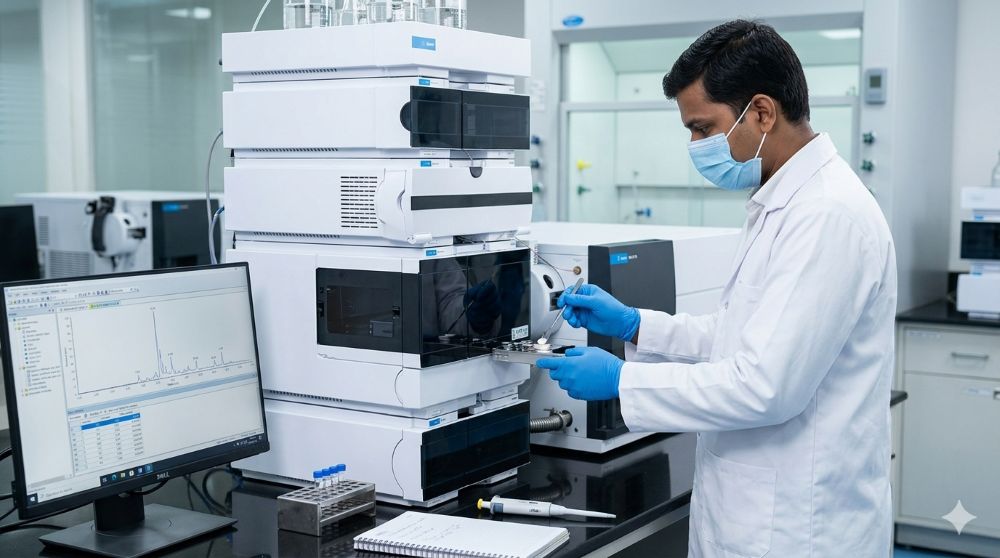
Your method is developed under NABL-accredited conditions per ICH Q14 — technique selection, column and solvent screening, forced degradation where stability-indicating capability is required, and preliminary qualification. All results pass through formal QA review including instrument log check, reference standard verification, and analyst sign-off before the development report is generated.
Receive Your NABL Report
Your NABL-accredited analytical development report is delivered digitally within the committed TAT. The report includes optimised method parameters, development rationale, forced degradation data where applicable, and a draft validation protocol formatted for the next ICH Q2(R2) validation phase. Reports are formatted for direct CDSCO, USFDA, and EMA submission. Track status via YLIMS throughout.
Project Timelines
| Scope | Standard TAT | Notes |
|---|---|---|
| Simple method development (single analyte, routine matrix) | 2 to 3 weeks | HPLC / UPLC / GC |
| Stability-indicating method development (full forced degradation) | 3 to 5 weeks | Acid, base, oxidative, photolytic, thermal |
| Complex multi-analyte method development | 4 to 6 weeks | Includes selectivity optimisation |
| Trace / bioanalytical LC-MS/MS method development | 4 to 8 weeks | ppb-level, NDSRIs, biomarkers |
| Method transfer with equivalence verification | 3 to 5 weeks | Statistical comparison per ICH Q2(R2) |
| Development + ICH Q2(R2) full validation package | 6 to 10 weeks | Single submission-ready deliverable |
Who Needs Analytical Development
- Pharma manufacturers requiring new analytical methods for CDSCO or USFDA submission, where existing pharmacopoeial methods do not cover the novel analyte or matrix.
- CDMO clients needing validated methods as part of the formulation development handover package to brand-owner clients.
- Generic drug developers requiring method development ahead of ANDA, ANDS, or dossier filing — particularly stability-indicating methods supporting ICH Q1 stability studies.
- API manufacturers requiring forced degradation studies to support ICH Q3A and Q3B impurity limits in the drug substance dossier.
- NCE and innovator drug development teams (Phase II, Phase III, NDA preparation) requiring method development and validation for a novel molecule.
- Companies migrating off legacy ICH Q2(R1) methods to the current ICH Q2(R2) framework and needing fresh validation evidence.
- Brand owners conducting method transfer from a development lab into in-house QC — needing the equivalence verification report.
- Drug-device combination product developers needing E&L method development for container-closure and device materials.
Why Auriga for Analytical Development
110+ HPLC/UPLC + 605 Columns
110+ HPLC and UPLC systems with 605 chromatography columns across the group — no sourcing delays, no waiting on column availability, parallel capacity for multi-batch development programmes.
9 LC-MS/MS Units
Nine LC-MS/MS units dedicated to complex-matrix method development — nitrosamines, NDSRIs, trace impurities, bioanalytical PK/PD, and ppb-level confirmation across pharma and CRO workflows.
Manesar USFDA Inspected
Method development and validation at Manesar (Plot 136, Sector 5, IMT Manesar) — the USFDA Inspected facility. Method development data accepted in USFDA dossiers without re-validation.
ICH Q2(R2) and Q14 Compliant
Documentation formatted against the current ICH Q14 (development) and ICH Q2(R2) (validation) framework — ready for direct submission to CDSCO, USFDA, EMA, and Health Canada.
Method Transfer Across Group Labs
Methods developed at Manesar can be transferred to Delhi, Bangalore, or Baddi under documented equivalence verification — for high-volume routine analysis without losing the development-stage method integrity.
Arbro Group Heritage Since 2003
Unbroken NABL ISO/IEC 17025:2017 accreditation since 2003. Arbro Lab since 1990, Auriga Research since 2007 — the audit trail USFDA, EMA, CDSCO, and CDMO clients look for in a method development partner.