
Nitrosamine Testing in Pharmaceuticals | LC-MS/MS | NABL Accredited | Auriga Research
Nitrosamines are probable human carcinogens classified as genotoxic impurities under ICH M7. Their detection in sartans, ranitidine, and metformin from 2018 onwards triggered international regulatory action that has since expanded into an industry-wide compliance programme. All pharmaceutical manufacturers must now assess and control nitrosamine impurities in APIs and finished drug products per ICH M7 and the FDA Nitrosamine Guidance Revision 2 (September 2024), the current FDA reference that replaces the 2020 and 2023 versions.
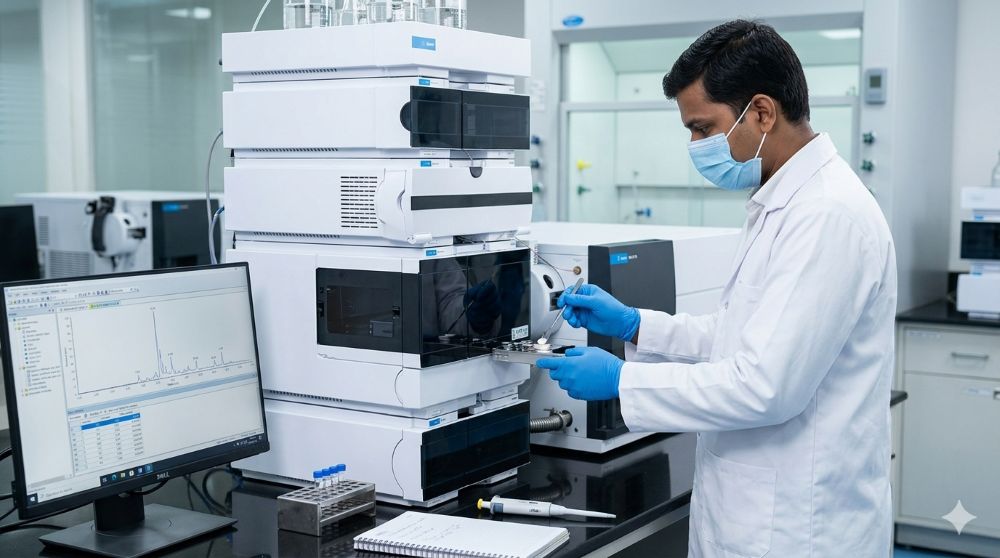
Auriga Research provides nitrosamine testing and method development for drug substances, drug products, and NDSRIs (drug substance-related nitrosamine impurities, governed by the FDA NDSRI RAIL Guidance of August 2023) using LC-MS/MS, GC-MS/MS, and GC headspace platforms. The 13-compound ICH M7 Appendix 2 panel is reported with compound-specific acceptable daily intake limits; custom NDSRI methods are developed where the API itself is the source of the nitrosamine.
Testing is delivered across three labs — routine screening at Delhi HQ (Arbro Analytical Division) and Bangalore, and method development and validation at Manesar (Plot 136, Sector 5, IMT Manesar) — the USFDA Inspected facility. NABL-accredited (ISO/IEC 17025:2017) reports are accepted by CDSCO, USFDA (dossier inclusion), EMA, and Health Canada for nitrosamine compliance submissions.
Six Nitrosamine Testing Services
Each card maps the test type to the analytical method, the governing regulatory reference, and the Auriga lab where it is performed.
Nitrosamine Screening
LC-MS/MS quantification of NDMA, NDEA, NMBA, NMOR, NDIPA, NDPA, NDBA, and other common nitrosamines per ICH M7 and FDA Guidance Rev 2 (Sep 2024). Routine testing at Delhi, Bangalore, and Manesar.
NDSRI Testing
Drug substance-related nitrosamine impurity testing by LC-MS/MS per the FDA NDSRI RAIL Guidance (August 2023). Carcinogenic Potency Categorisation Approach applied where no compound-specific TD50 exists. Delhi, Bangalore, and Manesar.
Volatile Nitrosamine Testing
NDMA and NDEA in headspace by GC-MS/MS and GC headspace methods per ICH M7. Suited to volatile-dominant matrices and orthogonal confirmation of LC-MS/MS quantitation. Delhi and Bangalore.
Method Development for Nitrosamines
LC-MS/MS and GC-MS/MS method development for novel APIs, NDSRIs, and matrix-specific challenges per ICH Q2(R2) and ICH M7. Conducted at the Manesar (USFDA Inspected) facility.
Method Validation for Nitrosamines
Full ICH Q2(R2) validation package — specificity, linearity, accuracy, precision, LOD, LOQ, robustness, and stability of analytical solution — for LC-MS/MS nitrosamine methods. Manesar and Delhi.
Nitrosamine Risk Assessment Support
Documentation review and gap analysis for the ICH M7 Step 2 nitrosamine risk assessment dossier. Supports CDSCO, FDA, and EMA submission readiness. All labs.
Acceptable Daily Intake Limits (ICH M7 Appendix 2)
Thirteen nitrosamine impurities with the acceptable intake (AI) limits per ICH M7 Appendix 2. The product-specific limit is calculated against the maximum daily dose of the drug product.
| Nitrosamine Impurity | Acceptable Intake Limit |
|---|---|
| NDMA (N-Nitrosodimethylamine) | 96 ng/day |
| NMBA (N-Nitroso-N-methyl-4-aminobutyric acid) | 96 ng/day |
| NMOR (N-Nitrosomorpholine) | 127 ng/day |
| NDEA (N-Nitrosodiethylamine) | 26.5 ng/day |
| NEIPA / NIEA / NIPEA / EPINA | 26.5 ng/day |
| NDIPA (N-Nitrosodiisopropylamine) | 26.5 ng/day |
| NDELA (N-Nitrosodiethanolamine) | 26.5 ng/day |
| NDPA (N-Nitrosodi-n-propylamine) | 26.5 ng/day |
| NDBA (N-Nitrosodi-n-butylamine) | 26.5 ng/day |
| NMEA (N-Nitroso-N-methylethylamine) | 26.5 ng/day |
| N-Ethyl-N-Nitroso-ethane-1,2-diamine | 26.5 ng/day |
| NMPA (N-Nitroso-N-methylphenethylamine) | 26.5 ng/day |
| MeNP (Methylnitrosamino-propanal) | 26.5 ng/day |
Limits per ICH M7 Appendix 2. CDSCO may specify different compound-specific limits — confirm with the regulatory team at quote stage.
How It Works
Get a Quote
Share your molecule class, the regulatory authority requiring the test (CDSCO / USFDA / EMA / Health Canada), the API and finished product matrix, and whether you need screening only or method development and validation as well. Your SPOC confirms the correct method, the appropriate lab (Manesar for method development and validation, Delhi or Bangalore for routine screening), and the sample requirement.
Collect and Send Your Sample
Samples for nitrosamine testing must be sent in sealed containers at ambient temperature unless the compound is known to be temperature-sensitive. Confirm sample size with your SPOC at quote stage. Each sample is bar coded and registered in YLIMS, Auriga's in-house Laboratory Information Management System, on receipt.
Testing and QA Review
Your sample is tested against the confirmed ICH M7 method using LC-MS/MS, GC-MS/MS, or GC headspace as appropriate. All results pass through formal internal QA review including instrument log check, reference standard verification, isotope-labelled internal standard recovery check, and analyst sign-off before the report is generated.
Receive Your NABL Report
Your NABL-accredited report is delivered digitally within the committed TAT. Results are expressed against ICH M7 Appendix 2 acceptable daily intake limits with the product-specific limit calculated from your maximum daily dose. The report is formatted for inclusion in CDSCO, USFDA, and EMA dossiers without modification. Track status via YLIMS throughout.
Who Needs Nitrosamine Testing
- API manufacturers and drug product formulators required by FDA, EMA, or CDSCO to screen for nitrosamine impurities as part of ongoing dossier maintenance.
- Companies manufacturing sartans, ranitidine, metformin, or other high-risk molecule classes where nitrosamine formation pathways are documented.
- Pharmaceutical exporters to US and EU markets where nitrosamine compliance evidence is mandatory for marketing authorisation, registration renewal, and post-approval changes.
- CDMO and toll manufacturers whose clients have requested nitrosamine testing as part of their QC specification or release testing.
- Companies conducting root cause investigations following an OOS finding, a regulatory query, or a port-of-entry detention on nitrosamine levels.
- New drug development teams (Phase II, Phase III, NDA preparation) requiring method development and validation for nitrosamines in their novel compound.
- Generic manufacturers preparing ANDA submissions where the reference product has known nitrosamine concerns.
- Regulatory affairs and QA teams assembling Step 2 ICH M7 nitrosamine risk assessment dossiers for CDSCO, FDA, or EMA review.
Why Auriga for Nitrosamine Testing
9 LC-MS/MS Units Across 3 Labs
Nine LC-MS/MS units distributed across Delhi, Bangalore, and Manesar — dedicated capacity for nitrosamine testing without backlog, even under multi-batch or multi-product submission programmes.
LC-MS/MS + GC-MS/MS + GC Headspace
Methods cover both non-volatile nitrosamines by LC-MS/MS and volatile nitrosamines (NDMA, NDEA) by GC-MS/MS and GC headspace — all in the same organisation, with orthogonal confirmation available.
Method Development at USFDA-Inspected Manesar
ICH M7-compliant method development and validation at Manesar — the same Auriga facility that is USFDA Inspected. Methods developed against the FDA Rev 2 (Sep 2024) framework.
NDSRI Testing per Aug 2023 RAIL Guidance
API-derived NDSRI testing in scope per the FDA NDSRI RAIL Guidance of August 2023. Single lab for both common-nitrosamine and NDSRI requirements with consolidated reporting.
NABL Reports Accepted by CDSCO, USFDA, EMA
NABL-accredited (ISO/IEC 17025:2017) data accepted by CDSCO regulatory submissions, USFDA dossier inclusion, EMA filings, and Health Canada — without re-testing.
ICH M7 Step 2 Risk Assessment Support
Documentation review and gap analysis support for the ICH M7 Step 2 nitrosamine risk assessment dossier — generating the analytical evidence and gap remediation paths the dossier needs.
Regulatory References
- • ICH M7(R2) — Assessment and Control of DNA Reactive (Mutagenic) Impurities.
- • FDA Guidance for Industry — Control of Nitrosamine Impurities in Human Drugs, Revision 2 (September 2024).
- • EMA Guideline on Nitrosamine Impurities in Medicinal Products (June 2020 and subsequent updates).
- • FDA NDSRI RAIL Guidance — Recommended Acceptable Intake Limits for Nitrosamine Drug Substance-Related Impurities (August 2023).
- • CDSCO circulars on nitrosamine impurities in APIs and drug products.
- • ICH Q2(R2) — Validation of Analytical Procedures.