





Franz Diffusion Cell Testing Laboratory India | In Vitro Permeation Studies | NABL
Franz diffusion cell testing for topical and transdermal formulations from an NABL-accredited pharmaceutical laboratory in India.
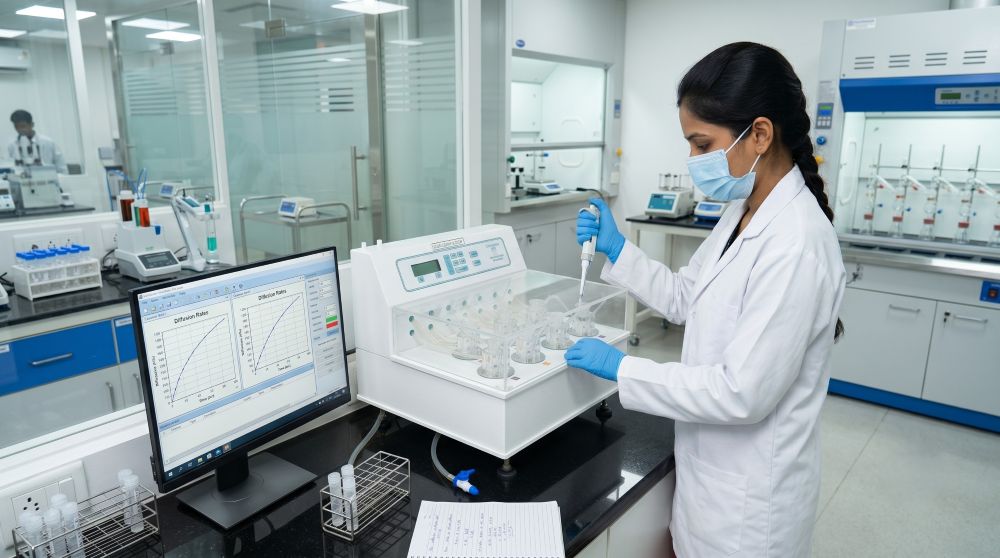
The Franz diffusion cell is the standard apparatus for measuring drug release and permeation from topical and transdermal pharmaceutical formulations. Auriga Research operates an NABL-accredited Franz diffusion cell testing laboratory at Manesar (Plot 136, Sector 5, IMT Manesar) — the USFDA Inspected facility, with automated multi-station systems for simultaneous testing across multiple replicates — producing statistically robust release and permeation data for formulation development, quality control, and regulatory submissions.
Auriga conducts Franz diffusion testing using synthetic membranes only — Strat-M or equivalent (polysulfone, regenerated cellulose, polyethersulfone) selected per the formulation type and regulatory purpose. Synthetic membranes provide reproducible barrier performance, regulatory acceptance for IVRT and comparative IVPT, and statistically robust data without the variability or supply constraints of biological tissue. Clients requiring biological skin studies (excised human or animal tissue) should enquire at quote stage — these are not within Auriga’s in-house scope and are routed to specialist partners where appropriate.
Both IVRT (In Vitro Release Testing) for quality control and IVPT (In Vitro Permeation Testing) for comparative formulation studies are performed under controlled, temperature-regulated receptor conditions. Testing protocols follow FDA SUPAC-SS guidance, USP 1724 for semisolid drug products, and the FDA Draft Guidance of May 2023 on IVPT for topical drug products submitted in ANDAs. Receptor samples are quantified using validated HPLC methods per ICH Q2(R2), with complete release / permeation profiles, flux and lag-time calculations, and statistical analysis included in the NABL-accredited report.
Service Scope: Synthetic Membranes Only
Auriga conducts Franz diffusion testing using synthetic membranes only — typically Strat-M or equivalent regenerated cellulose / polysulfone barrier membranes. Synthetic-membrane testing is the FDA SUPAC-SS, USP 1724, and FDA May 2023 IVPT framework for regulatory submissions. Clients requiring biological skin studies (excised human or animal tissue) should enquire at quote stage — these studies are not in our in-house scope.
Six Franz Diffusion Cell Testing Services
Each card maps the service to what is measured, the governing regulatory reference, and the synthetic-membrane approach used.
IVPT for Semisolid Formulations
In vitro permeation testing for creams, ointments, gels, and lotions across synthetic membranes per FDA SUPAC-SS guidance and USP 1724 performance tests.
IVPT for Transdermal Patches
Permeation testing of transdermal drug delivery systems across synthetic membranes per the applicable FDA topical guidance. Reservoir, matrix, and drug-in-adhesive patches in scope.
IVPT for Topical Liquids
In vitro permeation testing for topical solutions, lotions, and sprays across synthetic membranes — adapted to low-viscosity formulations with appropriate donor-compartment loading.
Permeation Rate and Steady-state Flux Determination
Cumulative release profile, lag time, permeation rate, and steady-state flux calculation across synthetic membranes for formulation development and quality benchmarking.
Method Development for Franz Cell Studies
Custom Franz diffusion method development including synthetic membrane selection, receptor medium optimisation, sampling-interval design, and ICH Q2(R2) HPLC method validation.
Comparative IVPT for Generic Topical Products
Test vs reference comparative IVPT studies per the FDA Draft Guidance of May 2023 ("In Vitro Permeation Test Studies for Topical Drug Products Submitted in ANDAs") using synthetic membranes.
Beyond Pharma — Industries We Serve
While pharmaceutical topical and transdermal formulations remain the primary focus, our Franz diffusion cell capability (synthetic membranes only) is also available for:
- Cosmetics & skincare brands — comparative active-ingredient release data for formulation development.
- Personal care formulation developers — comparative release across formulation variants.
- Chemical & material science — membrane permeability and release characterisation for polymers, coatings, and functional materials.
Project Timelines
Indicative TAT from sample receipt at Manesar. Confirm exact timeline with your SPOC at quote stage based on synthetic membrane choice, sampling interval design, and sample queue.
| Service Type | Turnaround Time |
|---|---|
| Standard IVRT / IVPT (established method) | 7 to 10 business days |
| Rush IVRT / IVPT | 5 to 7 business days |
| Comparative Permeation Study (ANDA support) | 10 to 14 business days |
| Method Development + ICH Q2(R2) Validation | 2 to 3 weeks |
How It Works
Get a Quote
Share your formulation type, regulatory purpose (ANDA biowaiver, NDA dossier, or formulation comparison), and whether you need method development or testing against an existing validated method.
Collect and Send Your Sample
Prepare your sample per instructions confirmed by your SPOC at quote stage. Each sample is bar coded and registered in YLIMS on receipt.
Testing and QA Review
Your sample is tested under NABL-accredited conditions. All results pass through formal QA review including instrument log check, reference standard verification, and analyst sign-off.
Receive Your NABL Report
Your NABL-accredited report is delivered digitally within the committed TAT, formatted for CDSCO, USFDA, and regulatory submission. Track status via YLIMS.
Who Needs Franz Diffusion Cell Testing
- Generic topical drug manufacturers conducting IVPT as part of an ANDA biowaiver strategy per the FDA May 2023 Draft Guidance.
- Pharma companies developing new semisolid formulations requiring synthetic-membrane permeation data for formulation comparison.
- CDMO clients requiring IVPT as part of formulation development, scale-up, and pre-versus-post-change comparison studies.
- Cosmetics and cosmeceutical brands requiring synthetic-membrane permeation data for formulation development and comparative claims work.
- Transdermal patch developers comparing reservoir, matrix, and drug-in-adhesive systems across formulation variants.
- QC teams running batch-to-batch IVRT compliance against an established synthetic-membrane release specification.
- Regulatory affairs teams preparing SUPAC-SS Level 2 / 3 change documentation requiring IVRT release-profile evidence.
- Topical liquid (solution, lotion, spray) developers needing flux and lag-time data for product development decisions.
Why Auriga for Franz Diffusion Cell Testing
#1 in India for Franz Diffusion Cell
Auriga is the recognised expert in India for Franz diffusion cell testing. The page ranks #1 nationally for the term — reflecting depth of buyer trust and operational track record.
Synthetic-Membrane IVPT with Validated Methods
Strat-M and equivalent synthetic membrane workflows with ICH Q2(R2) validated HPLC quantification per FDA SUPAC-SS and USP 1724. Reproducible, regulatory-acceptable, statistically robust.
NABL Reports Accepted by CDSCO and USFDA
NABL accredited (ISO/IEC 17025:2017) permeation data formatted for CDSCO and USFDA dossier inclusion. Manesar is USFDA Inspected — data accepted in submissions without re-testing.
FDA May 2023 ANDA Comparative IVPT
Test vs reference comparative IVPT per the FDA Draft Guidance of May 2023 for topical drug products submitted in ANDAs — supporting biowaiver pathways for topical generics.
Multi-Station Automated Systems
Automated multi-station Franz diffusion apparatus with independently temperature-controlled receptor compartments and programmable sampling protocols. Statistical robustness across 6 to 12 replicates per session.
Cross-Industry: Pharma, Cosmetics, Material Science
Synthetic-membrane Franz diffusion capability extends beyond pharma into cosmetics, personal care, and material science. One vendor, one validated platform, multiple use cases.
5+
NABL Accredited Labs
5 Cities
Delhi · Manesar · Bahadurgarh · Baddi · Bangalore
12,000+
Clients Served
1985
Arbro Group · Auriga Research
Regulatory References
- • FDA SUPAC-SS — Scale-Up and Post-Approval Changes for Nonsterile Semisolid Dosage Forms (CDER 1997).
- • USP <1724> — Semisolid Drug Products: Performance Tests.
- • FDA Draft Guidance, May 2023 — In Vitro Permeation Test Studies for Topical Drug Products Submitted in ANDAs.
- • ICH Q2(R2) — Validation of Analytical Procedures (March 2024).
- • Service Scope — Synthetic membranes only. Biological skin studies (excised human or animal tissue) not in scope.