




DSC Analysis Laboratory India | Differential Scanning Calorimetry | NABL
DSC analysis — Differential Scanning Calorimetry (DSC full form) — from an NABL-accredited pharmaceutical testing laboratory in India.
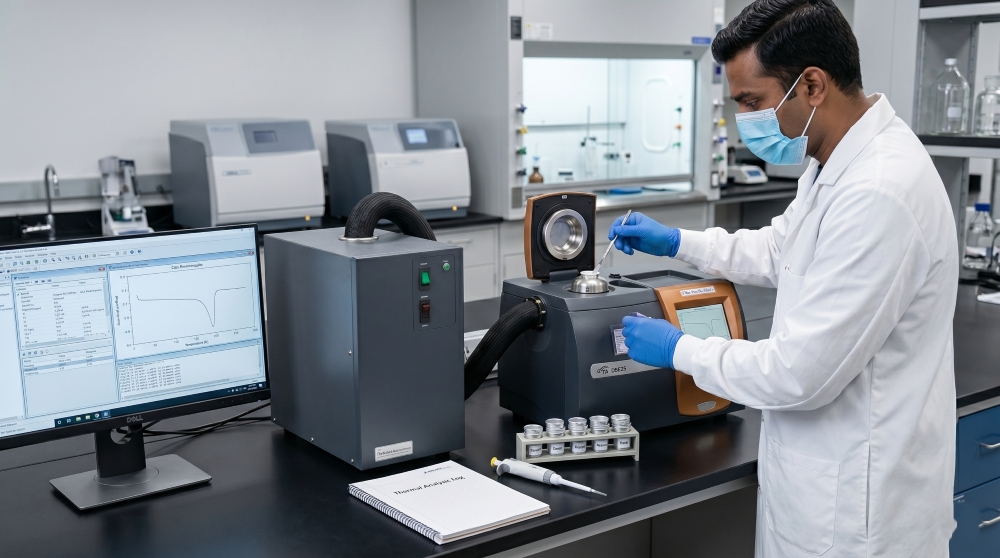
DSC stands for Differential Scanning Calorimetry. It is one of the most widely used thermal-analysis techniques in pharmaceutical development and quality control. DSC measures the heat-flow difference between a sample and an inert reference as both are heated, cooled, or held at a constant temperature — revealing melting points, enthalpies of fusion, glass transitions, polymorphic transformations, and thermal interactions. Auriga Research operates an NABL-accredited DSC analysis facility at Manesar (Plot 136, Sector 5, IMT Manesar) — the USFDA Inspected site.
Pharmaceutical applications of DSC are extensive. The technique provides definitive data on polymorphic-form identity through characteristic melting endotherms, enabling polymorph screening per ICH Q6A and batch-to-batch consistency checks for ANDA and CDSCO dossiers. For purity determination, DSC applies the van't Hoff melting-point-depression equation — a rapid, material-efficient alternative to chromatographic methods. Glass transition (Tg) measurements are critical for amorphous solid dispersions and spray-dried intermediates where stability depends on maintaining the amorphous state.
DSC analysis also supports API-excipient compatibility screening, where binary mixtures are heated to detect new thermal events that signal interaction — a standard preformulation deliverable before formulation lock. Combined with TGA, XRD, and FTIR data, DSC forms the core of solid-state characterisation packages required for CTD Module 3 regulatory submissions to CDSCO, USFDA, and EMA.
Six DSC Analysis Services
Each card maps the DSC service to the analytical purpose and the governing regulatory or pharmacopoeial reference where applicable.
Melting Point Determination
DSC melting point and enthalpy of fusion determination per USP 891 (Thermal Analysis) and IP general thermal-analysis methods. Suited to API and intermediate identity confirmation.
Polymorphism Screening
Polymorphic form identification and screening via characteristic melting endotherms and enthalpies of fusion per ICH Q6A. Supports CDSCO and ANDA polymorph data requirements.
Glass Transition (Tg) Measurement
Glass transition temperature (Tg) measurement for amorphous solid dispersions, spray-dried intermediates, and lyophilised products where amorphous-state stability is critical.
Purity Analysis by DSC
Purity determination using the van't Hoff melting-point depression method. A rapid, material-efficient alternative to chromatography for early-stage API purity assessment.
API-Excipient Compatibility Studies
Binary-mixture DSC screening to detect new thermal events that signal API-excipient interaction. Standard preformulation deliverable before formulation lock.
Heat of Fusion and Crystallinity Assessment
Heat of fusion (ΔHf) and percent crystallinity measurement for crystalline-amorphous mixtures, polymorph quantification, and solid-state stability monitoring.
Project Timelines
Indicative TAT from sample receipt at Manesar. Confirm exact timeline with your SPOC at quote stage based on technique combination and sample queue.
| Service Type | Turnaround Time |
|---|---|
| Standard DSC Analysis | 5 to 7 business days |
| Rush DSC Analysis | 2 to 3 business days |
| Combined DSC + TGA Package | 7 to 10 business days |
| Full Solid-State (DSC + TGA + XRD + FTIR) | 10 to 14 business days |
How It Works
Get a Quote
Share your compound, phase of development, and characterisation question — polymorph screening, compatibility, or Tg. Your SPOC confirms sample quantity, preparation, and TAT.
Collect and Send Your Sample
Prepare your sample per instructions confirmed by your SPOC at quote stage. Each sample is bar coded and registered in YLIMS on receipt.
Testing and QA Review
Your sample is tested under NABL-accredited conditions. All results pass through formal QA review including instrument log check, reference standard verification, and analyst sign-off.
Receive Your NABL Report
Your NABL-accredited report is delivered digitally within the committed TAT, formatted for CDSCO, USFDA, and regulatory submission. Track status via YLIMS.
Who Needs DSC Analysis
- Pharma formulators screening polymorphic forms during early API development per ICH Q6A.
- Generic manufacturers requiring polymorph data for ANDA or CDSCO dossier submission.
- Stability teams characterising solid-state changes during accelerated stability studies.
- CDMO clients needing API-excipient compatibility data before formulation lock.
- R&D scientists measuring glass transition (Tg) for amorphous solid dispersions and spray-dried intermediates.
- Quality control labs running batch-to-batch identity, melting point, and crystallinity checks.
- Regulatory affairs teams compiling solid-state characterisation data for CTD Module 3 submissions.
- Lyophilised product developers measuring collapse and glass transition temperatures of freeze-dried matrices.
Why Auriga for DSC Analysis
DSC at Manesar + XRD at Baddi + FTIR at 3 Labs
Complete solid-state characterisation from one organisation: DSC and TGA at Manesar, XRD at Baddi, FTIR at Delhi, Manesar, and Bangalore. Single point of contact, one report, one timeline.
USFDA Inspected at Manesar
DSC data generated at Manesar — the same Auriga facility that is USFDA Inspected. Reports formatted for inclusion in USFDA dossiers without re-testing.
ICH Q6A Compliant Polymorph Screening
Polymorph screening per ICH Q6A — endotherm comparison, enthalpy of fusion, and stoichiometry — with data formatted for CDSCO and USFDA submission.
NABL Reports Accepted by CDSCO, USFDA, EMA
NABL accredited (ISO/IEC 17025:2017) DSC reports accepted by CDSCO regulatory submissions, USFDA dossier inclusion, and EMA filings without re-testing.
Preformulation to QC Coverage
From early-stage compatibility screening through ANDA-grade polymorph characterisation to QC batch identity — Auriga supports DSC at every phase of the product lifecycle.
Combined Thermal Packages
DSC + TGA combined packages delivered as a single deliverable. Add XRD and FTIR for full solid-state characterisation in one consolidated NABL report.
5+
NABL Accredited Labs
5 Cities
Delhi · Manesar · Bahadurgarh · Baddi · Bangalore
12,000+
Clients Served
1985
Arbro Group · Auriga Research
Regulatory References
- • ICH Q6A — Specifications: test procedures and acceptance criteria for new drug substances and new drug products, including polymorphism characterisation.
- • USP <891> — Thermal Analysis (general chapter).
- • IP General — Indian Pharmacopoeia thermal-analysis general references.
- • ICH Q2(R2) — Validation of Analytical Procedures (March 2024).
- • CTD Module 3 — Solid-state characterisation data requirements for CDSCO, USFDA, and EMA submissions.